Servo Hydraulic Press for Brake Backing Plate: Deep Drawing & NRS Pin Forming Solution
Introduction: Precision Forming for Reliable Brake Components
In automotive braking systems, manufacturing precision is not optional. Brake backing plates must maintain dimensional accuracy, structural consistency, and reliable compatibility with other brake components throughout their service life.For manufacturers producing drum brake backing plates and related brake steel components, two critical manufacturing operations are deep drawing and NRS (Noise Reduction Shim) pin forming. Both processes demand controlled forming forces, repeatable positioning, and reliable tooling performance.
At Goodsjack Hydraulic Machinery, we develop customized servo hydraulic press solutions for demanding metal forming applications. Our hydraulic press technology is designed to support brake backing plate deep drawing, pin forming, upsetting, blanking, and other related forming operations.
By combining programmable hydraulic motion control, adjustable pressure, precision tooling integration, and automation-ready machine configurations, we help automotive component manufacturers improve production consistency and build more efficient manufacturing processes.
Whether you are developing a new brake backing plate production line or upgrading an existing forming process, Goodsjack provides hydraulic press solutions tailored to your product geometry, material specifications, and production requirements.

1. Understanding the Brake Backing Plate Manufacturing Process
A brake backing plate is a structural component of a drum brake assembly. It provides a mounting foundation for brake shoes, wheel cylinders, springs, and other brake hardware.Depending on the vehicle platform and brake design, backing plates may feature different contours, mounting holes, drawn sections, reinforcement areas, and pin attachment structures.
The manufacturing process typically involves several operations:
• Sheet metal blanking and preparation
• Deep drawing and contour forming
• Piercing and hole processing
• Brake pin forming or upsetting
• Coining and dimensional calibration
• Surface treatment and quality inspection
The exact production sequence depends on the component design, material thickness, tooling configuration, and required production volume.
Among these operations, deep drawing and NRS-related pin forming are particularly important when the component design requires integrated drawn features and accurately formed pin structures.
A properly configured hydraulic press can provide the controlled forming conditions needed to perform these operations consistently.
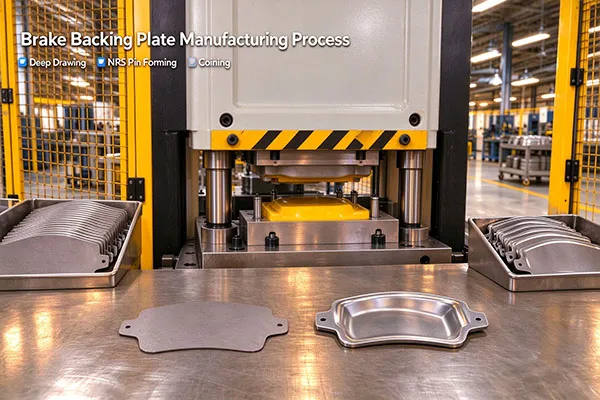
2. Deep Drawing of Brake Backing Plates: Why Press Control Matters
Deep drawing is a metal forming process that transforms flat sheet metal blanks into components with three-dimensional geometries.For brake backing plates, the process may involve forming recessed sections, raised contours, mounting features, or other structural profiles according to the part design.
Unlike simple blanking or punching, deep drawing requires careful coordination between forming force, slide movement, material flow, and die design.
Key Requirements for Brake Backing Plate Deep Drawing
1. Controlled forming pressure
Insufficient forming force may result in incomplete forming, while excessive force can increase the risk of material damage, depending on the material and die conditions.
A servo hydraulic press allows forming pressure to be adjusted to suit different process stages and component requirements.
2. Programmable slide movement
The forming process may require different speeds during approach, material engagement, drawing, and return.
Programmable slide movement helps manufacturers establish a suitable motion profile for each stage rather than relying on a single fixed operating speed.
3. Consistent forming depth
Accurate control of the working stroke is important for maintaining the geometry of formed sections.
A suitable hydraulic control system, together with properly designed tooling and positioning references, helps improve dimensional repeatability.
4. Stable tooling conditions
The interaction between the punch, die, blank holder, and sheet material directly affects forming quality.
The hydraulic press must provide sufficient structural rigidity and appropriate force distribution to support the selected tooling configuration.
How Goodsjack Servo Hydraulic Press Supports Deep Drawing
Goodsjack servo hydraulic presses can be configured with programmable pressure, adjustable stroke, and controlled slide movement to accommodate different brake backing plate designs.
Depending on the application, the machine can incorporate:
• Adjustable forming pressure and working speed
• Programmable stroke and position settings
• Multi-stage forming control
• Pressure and position monitoring
• Customized die mounting arrangements
• PLC-based operation and touchscreen control
• Automated material loading and unloading interfaces
These capabilities allow manufacturers to optimize forming parameters according to actual production conditions.
The objective is straightforward: achieve reliable part geometry, maintain process consistency, and reduce unnecessary adjustments during production.
3. NRS Pin Forming: Precision for Brake Component Assembly
NRS-related pin forming is another important consideration in certain brake backing plate manufacturing applications.Depending on the brake design, NRS (Noise Reduction Shim) systems use dedicated hardware and attachment features to help manage vibration and noise in the braking assembly.
Where the design incorporates formed or attached pins, these features must meet specific dimensional and mechanical requirements to ensure proper compatibility with the corresponding components.
Pin forming may involve upsetting, localized compression, material displacement, or other specialized forming operations depending on the pin geometry and manufacturing method.
Key Challenges in Brake Pin Forming
Accurate pin dimensions
Pin height, diameter, head geometry, and forming position must be controlled according to the component drawing and assembly requirements.
Consistent forming force
An appropriate forming force helps produce repeatable pin geometry while avoiding excessive deformation or damage to the surrounding material.
Reliable positioning
The pin and backing plate must be correctly positioned during forming. Tooling alignment and workpiece location are essential for achieving consistent results.
Repeatable production quality
In high-volume automotive manufacturing, variation between production cycles can affect downstream assembly and inspection. Stable process parameters are therefore important.
Servo Hydraulic Control for Pin Upsetting and Forming
Servo hydraulic technology offers flexible control over pressure, speed, and slide movement.
For brake pin forming applications, a customized servo hydraulic press can be configured to provide:
• Adjustable pressing force for different pin specifications
• Controlled forming speed during material deformation
• Programmable stroke and forming position
• Repeatable working cycles
• Pressure monitoring and process adjustment
• Integration with dedicated pin feeding and positioning systems
For applications requiring multiple forming stages, the control program can be configured to coordinate different movement and pressure settings within one production cycle.
The final machine configuration depends on the pin material, dimensions, forming method, tooling design, and required production capacity.
4. Why Choose a Servo Hydraulic Press for Brake Backing Plate Production?
Traditional hydraulic presses and mechanical stamping presses each have their own advantages. However, when a manufacturing process requires flexible pressure control, adjustable slide movement, and multiple forming stages, servo hydraulic technology offers important advantages.Here is how a servo hydraulic press can benefit brake component manufacturers.
4.1 Flexible Pressure and Speed Control
Different stages of deep drawing and pin forming may require different force and speed settings.
A servo hydraulic press allows operators to program process parameters to match the forming requirements of each component.
This flexibility is particularly valuable when manufacturers produce multiple brake backing plate models on the same production line.
4.2 Improved Process Repeatability
Consistent forming conditions help reduce variations between production cycles.
By using programmable control and suitable pressure and position monitoring, manufacturers can establish repeatable operating parameters for recurring production jobs.
Actual dimensional accuracy still depends on machine rigidity, tooling precision, material consistency, and process validation.
4.3 Energy-Efficient Hydraulic Operation
Compared with conventional hydraulic systems that operate pumps continuously at relatively fixed output conditions, a properly designed servo-driven hydraulic system can adjust motor and pump operation according to actual process demand.
This can reduce unnecessary energy consumption during standby and low-demand operating periods.
The actual energy savings depend on the machine configuration, operating cycle, production volume, and application.
4.4 Flexible Production for Multiple Part Specifications
Automotive component manufacturers often need to process different backing plate sizes and designs.
Programmable operating parameters make it easier to adjust working speed, pressure, and stroke for different production requirements.
With appropriate tooling changes and machine configurations, one press platform may support multiple related forming applications.
4.5 Automation Integration
A servo hydraulic press can be designed to work with automated production equipment, including:
• Automatic sheet feeding systems
• Robotic loading and unloading
• Part positioning mechanisms
• Automatic transfer systems
• Safety light curtains and protective enclosures
• Production monitoring and data collection systems
This creates opportunities to reduce manual handling, improve production flow, and support more consistent manufacturing operations.
5. Customized Hydraulic Press Solutions for Brake Backing Plate Manufacturing
There is no universal hydraulic press configuration suitable for every brake backing plate production line.The required machine capacity, working area, stroke, opening height, operating speed, and tooling arrangement must be determined according to the actual forming process.
At Goodsjack Hydraulic Machinery, we focus on application-specific hydraulic press engineering rather than simply offering standard machine specifications.
Our engineering team can work with customers to evaluate the following factors.
| Configuration | Key Considerations |
| Press capacity | Maximum forming force required by the process |
| Working table | Component dimensions and die installation requirements |
| Slide stroke | Required forming depth and working travel |
| Opening height | Die height and workpiece loading space |
| Operating speed | Forming cycle and production efficiency |
| Control system | PLC, touchscreen, and programmable process settings |
| Hydraulic system | Servo drive, pump configuration, and pressure control |
| Automation | Feeding, positioning, unloading, and transfer requirements |
From Individual Presses to Integrated Production Lines
Depending on production requirements, Goodsjack can provide solutions ranging from individual hydraulic forming machines to customized automated press systems.
For brake backing plate manufacturing, a production solution may include:
1. Sheet material feeding and positioning
2. Blanking or preforming operations
3. Hydraulic deep drawing
4. Pin forming or upsetting
5. Secondary forming and calibration
6. Automated unloading and inspection
Not every application requires all operations to be integrated into one machine. Some processes are better handled through separate stations to achieve the required cycle time, tooling arrangement, and production flexibility.
Our approach is to evaluate the complete manufacturing process before recommending a suitable press configuration.
6. How Goodsjack Develops a Hydraulic Press for Your Application
Selecting a hydraulic press based only on tonnage is not enough.A successful forming solution requires a clear understanding of the component, material, tooling, production process, and final quality requirements.
Goodsjack follows an application-oriented approach to hydraulic press customization.
Step 1: Understand the Component
We review the brake backing plate drawings, dimensions, material specifications, thickness, and required forming features.
Step 2: Evaluate the Forming Process
Our team studies the deep drawing, pin forming, upsetting, and other relevant manufacturing operations to understand the required force, stroke, and working conditions.
Step 3: Determine the Machine Configuration
Based on the process requirements, we evaluate press capacity, table dimensions, opening height, slide travel, hydraulic system, and control configuration.
Step 4: Develop the Customized Solution
The machine configuration is developed around the customer's tooling and production requirements, with automation options considered where necessary.
Step 5: Manufacturing and Testing
The hydraulic press is manufactured and inspected according to the agreed technical specifications. Relevant operating functions and machine performance can be checked before delivery.
Step 6: Installation and Technical Support
Goodsjack can provide technical support for machine installation, commissioning, operation, and maintenance according to the project agreement.
Our goal is to help customers establish a practical and reliable forming solution that meets their production requirements.
Conclusion: Build a More Flexible Brake Backing Plate Production Process with Goodsjack
Brake backing plate manufacturing requires more than sufficient pressing force. Deep drawing and NRS-related pin forming demand coordinated control of pressure, speed, stroke, tooling, and workpiece positioning.A properly configured servo hydraulic press provides manufacturers with the flexibility to optimize these forming operations, improve process consistency, and adapt to changing product specifications.
At Goodsjack Hydraulic Machinery, we combine hydraulic press engineering, customized machine manufacturing, and application-oriented technical support to develop solutions for demanding metal forming applications.
Whether you need a servo hydraulic press for brake backing plate deep drawing, NRS pin upsetting, or an integrated automotive component production line, we are ready to discuss your project.
Looking for a customized hydraulic press for brake backing plate manufacturing?
Send us your product drawings, material specifications, and production requirements. Our engineering team will help evaluate a suitable servo hydraulic press solution for your application.
Contact Goodsjack Hydraulic Machinery to discuss your brake backing plate forming project.
From the (SZX)Shenzhen Bao'an International Airport and (CAN)Guangzhou Baiyun International Airport to our factory 1.5 hour's driving. Warmly welcome to visit us at any time.
Delishi Machinery Technology Co.,Ltd.
Goodsjack Hydraulic Machinery Co.,Ltd.Tel: +86-769-88057683 83223615
Fax: +86-769-83231691
Address: No3 Jinfu Road, Jinma Industrial Park, Liaobu, Dongguan City, GuanDong Province, China
E-mail: info@goodsjack.com, sales@goodsjack.com, info@dgdelishi.com
WhatsApp/Wechat: +86-13642957273 Alice
WhatsApp/Wechat: +86-13509801050 Eva


评论
发表评论